
#27 One Codebase, 7.02 to ABAP Cloud
Most SAP landscapes are currently two landscapes. Something old that runs the business, something new that is being built beside it, and a migration between them measured in years rather than sprints. Anything written for one side is usually written again for the other. It is why so much internal tooling exists twice and works in one and a half places.
abap2UI5 asks very little of the release it runs on, and that is not a design achievement so much as a consequence of what the framework does. It produces two strings and moves them over HTTP. There is no CDS artifact, no RAP object, no OData service in the middle, so there is almost nothing a given release has to support.
Almost. What does differ — GUID creation, base64 and code page conversion, finding the classes that implement an interface, the HTTP request and response objects and a handful more — sits in two utility classes, written to satisfy both language versions at once through dynamic calls: ABAP Cloud and Standard ABAP, from a single code line.
The rest is arithmetic. New ABAP syntax is written normally in the main repository, and abaplint generates the low-syntax branch automatically, down to 7.02. Hand-downporting would produce a second codebase that drifts and that nobody can debug; a generated one cannot drift, because it is regenerated.
And the frontend does not age with the backend. UI5 is bootstrapped from a CDN, so the UI5 version is a configuration decision rather than a property of the SAP release. A control released this year works on a system that has never heard of this year.
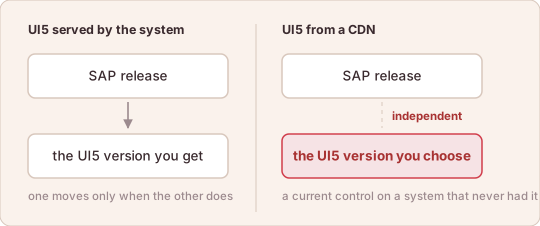
Where UI5 comes from decides whether its version follows the SAP release.
What that buys is portability in both directions. An app written on ABAP Cloud runs on the older system. An app written on 7.02 runs on BTP ABAP Environment. The screen built for the system being replaced is not thrown away with it — which, for anybody in the middle of a conversion project, is the interesting sentence in this article.
A framework that needs nothing from the release does not have to be ported when the release changes.