In a Nutshell
Build UI5 Apps Purely in ABAP
abap2UI5 is an open-source framework that brings the simplicity of classic ABAP development to modern UI5 apps. Just as Selection Screens and ALV grids let you build working UIs with only a few lines of ABAP, abap2UI5 brings that same simplicity to modern web apps:
CLASS zcl_my_app DEFINITION PUBLIC.
  PUBLIC SECTION.
    INTERFACES z2ui5_if_app.

  PROTECTED SECTION.
  PRIVATE SECTION.
ENDCLASS.

CLASS zcl_my_app IMPLEMENTATION.
  METHOD z2ui5_if_app~main.
    client->message_box_display( `Hello World` ).
  ENDMETHOD.
ENDCLASS.That's it — your first UI5 app is ready. client is the single parameter of main, passed in by the framework. The Hello World page runs this same class in your system and explains it.
A finished app looks like any other UI5 app, because it is one — a selection screen, a table, a dialog, all of it built from the same single class:
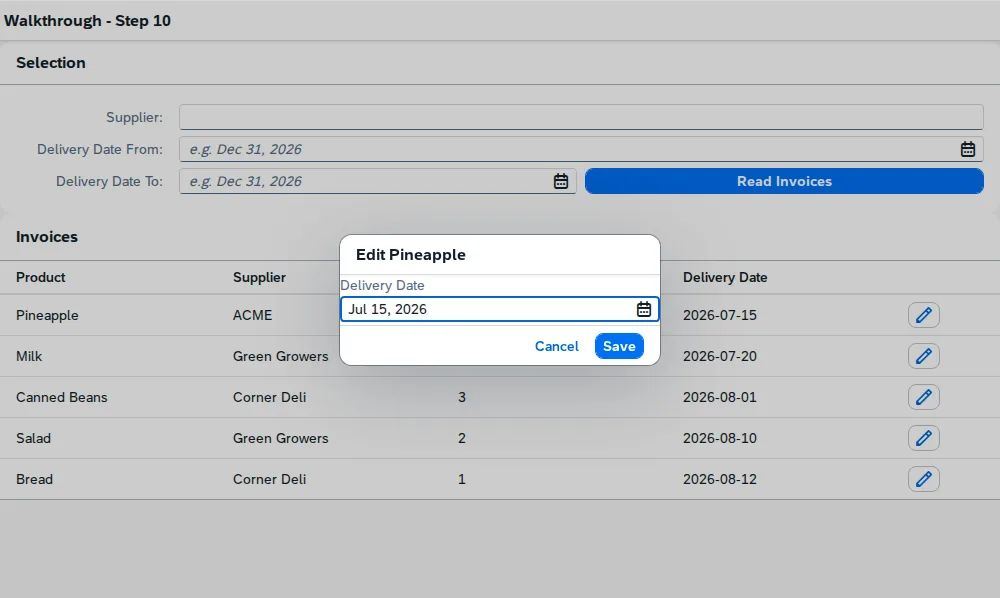
→ The Tutorial grows exactly this app in twelve steps, each one a complete class you can run in the browser — then takes it to production, and under unit tests
Next: install it
The Quickstart takes you from abapGit to a running app in three steps. No system at hand? The playground runs the same class in your browser.
This page is the technical picture: what an app is, how one click travels, and what it runs on. What abap2UI5 means for an organization — what it can build, how it compares, what it costs — is on abap2UI5 for decision makers.
How It Works
The frontend is a UI5 shell that only renders. Your ABAP class builds a UI5 XML view. The framework sends it to the browser in one response, together with the JSON model its controls bind to. Every user interaction comes back as a fresh call into main( ). No OData service sits in between.
One click is one roundtrip: the browser sends a request, main( ) runs once, the answer comes back. No ABAP session waits between two clicks. After each roundtrip the framework saves your app object on the server, and the browser keeps only the id of that copy. Before the next call of main( ) the copy is restored, so your app is exactly as the user left it. The saved copy is called the app draft (it is not a RAP draft). This makes an app stateless like any other UI5 app, which is what makes it scale. Every word is in the Glossary. For the few cases that need a pinned session, a stateful mode exists.
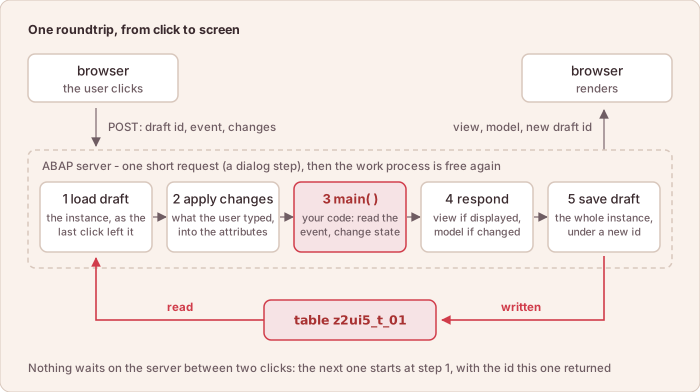
→ The Insights take each of the five steps apart, and compare the result with RAP and UI5 freestyle
Outside the SAP world this pattern has a name — HTML Over-the-Wire, the idea behind htmx, Hotwire and Phoenix LiveView. abap2UI5 applies it to UI5.
What Follows from That
- A thin frontend. The browser only renders. Logic, data and state stay in the backend, so there is nothing to configure on the client and no cache to clear.
- One request per click. The data comes in the same response as the view: no OData call per control. → Performance
- No service to query from outside. The browser gets only what the app puts into the view. Logon is the job of the ICF node, as for any service. Authorization checks stay yours, in the app. → Security, Authorization
- A small footprint. Classes, interfaces and one table for the app drafts. Everything else is an optional add-on.
Compatibility
abap2UI5 uses released APIs only, so the same source runs on ABAP Cloud and on Standard ABAP; CDS, ABAP SQL and EML are available inside an app where the system has them.
System Support
Works with both ABAP Cloud and Standard ABAP:
- S/4 Public Cloud and BTP ABAP Environment (ABAP for Cloud)
- S/4 Private Cloud or On-Premise (ABAP for Cloud, Standard ABAP)
- R/3 NetWeaver AS ABAP 7.02 or later (Standard ABAP)
Below 7.50 you pull the X.Y.Z-702 tag instead of X.Y.Z — same features, generated from main automatically; the Quickstart table says which tag belongs to which system. See Downporting.
UI5 Versions
The frontend is UI5 itself, loaded at bootstrap like it is for any other UI5 app. abap2UI5 bootstraps OpenUI5 from its public CDN by default. A single exit points it at SAPUI5, at a fixed version, or at the UI5 already delivered by your own system. A system without internet access uses the last option. 1.71 is the oldest supported release, and every change is tested against UI5 2.x as well.
→ See UI5 Versions for the distributions, and Bootstrapping for choosing the source
Integration
Where an App Appears
An app runs in a browser tab on its own, or embedded into:
- Fiori Launchpads on S/4 On-Premise
- Tiles on S/4 Public Cloud
- Build Work Zone Websites on BTP
- Any UI5 app of your own, a Fiori elements page or a UI Integration Card, with the embed control (
@abap2ui5/embed-controlon npm) - A tab in Microsoft Teams, the task pane of Microsoft Excel, or a native app on iOS and Android
→ See Integration for every place an app can appear
Later
None of this is needed for a first app; each line is a page of its own.
- Tooling. A linter, an MCP server and a VS Code extension — see Tooling and Developing with AI.
- Without an SAP system. Every release is also published transpiled to JavaScript — see Working Off-Stack.
- Help and community. Support on GitHub and Slack, the Contribution Guide, and sponsorship if the project saves you time.