
#9 A New Instance on Every Request
Every request lands on a fresh instance of the app class. No session holds the previous one, and the next request may not even reach the same application server.
Which raises a fair question: how does anything the user typed three clicks ago still exist?
z2ui5_if_app inherits if_serializable_object, and that one line is the
answer. After each request the framework serializes the app instance into
z2ui5_t_01 — one generic table for every app, not a typed draft table per
data model — and reads it back on the next one. The browser gets a draft id,
and sends the draft id back. The state itself never leaves the server.
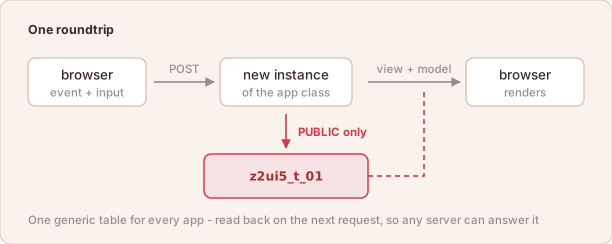
Every request is a new instance; z2ui5_t_01 is what carries the last one forward.
What survives is the whole instance, whatever the visibility of an attribute.
This trips people up, so it is worth saying twice: PUBLIC is not what keeps a
value alive — it is what _bind( ) needs in order to reach it, because the
framework resolves a bound attribute by name from outside the class. The two
sections have two different jobs:
  PUBLIC SECTION.
    " bound to the view - the framework reads and writes these by name
    DATA customer TYPE string.
    DATA items    TYPE ty_t_item.

  PROTECTED SECTION.
    " never bound - but serialized all the same
    DATA client   TYPE REF TO z2ui5_if_client.
    DATA t_cache  TYPE ty_t_catalog.
What does not survive is what the serializer cannot write: a local variable,
an open cursor, an acquired lock, a reference to a class that is not
serializable. The client reference above is set again on every call, which
is why me->client = client is the first line of every main( ).
And that single fact is the convention that catches people — including people who have been writing ABAP for twenty years, because in a dialog program this habit was free. A catalog read once and parked in an attribute is not a cached catalog. It is a payload that gets written to the database and read back after every single click, in either section, and it makes every click slower for as long as the app runs. The fix is not a keyword. Anything large is re-read per request instead of carried, and the instance stays the size of what the screen needs.
What that discipline buys is worth the rule. The app feels stateful — PBO, PAI, cancel, back — while every request is genuinely independent. Any server can answer any click. Nothing has to be sticky, drained before a restart, or replicated between nodes. Your Basis colleagues will never have to think about this app during a rolling restart. Take that as high praise.
Stateful for the user, stateless for the system — and the price is keeping the instance small.