
#23 100 Rows, Four Hours, One Request
Three numbers decide whether an abap2UI5 app feels fast, and none of them is in your code. Learn them before you bind your first table — the first one in particular has cost more debugging hours than it has any right to.
100 rows. Every UI5 JSON model exposes at most 100 items to a list binding by default. Bind a table with 300 entries and the first 100 render — the rest are silently dropped, with no error anywhere, in ABAP or in the browser console. It is a UI5 setting, not a framework one, and it is raised per view from ABAP:
    client->follow_up_action( val   = client->cs_event-set_size_limit
                              t_arg = VALUE #( ( `1000` )
                                               ( client->cs_view-main ) ) ).
Raising it is the fix for a table of a thousand rows. It is not the fix for a
table of fifty thousand: every bound row travels to the browser with the
response, and back to the database with the draft. A screen that needs that
many pages in ABAP — a SELECT with UP TO, a growing table, a filter bar —
the way a selection screen always did.
Four hours. The serialized instance from #9
lives in z2ui5_t_01 until it expires, four hours by default. A user who comes
back after lunch continues where they were; one who comes back tomorrow starts
fresh. The number is draft_exp_time_in_hours in the user exit, and this table
is the one place in the framework that grows — it is cleaned up on its own
schedule, and a system with many users and long-running screens sizes it like
any other table.
One request. Every click is one HTTP roundtrip plus one read and one write
of the draft. So the cost of a click is the size of the instance plus the size
of the model — and, as #9
warned, those are the same attributes. An app that carries a catalog of ten
thousand rows in an attribute pays for it on every single click, in either
section. An app that re-reads what it needs pays a SELECT, which the database
was built for and is extremely good at.
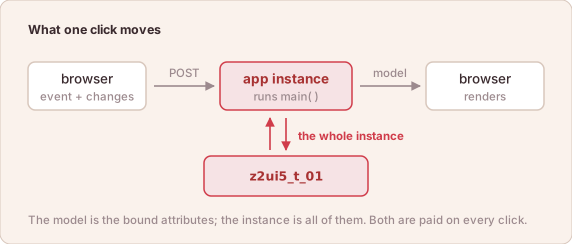
What a click costs: the instance to the database, the model to the browser.
The rule that follows is the same one a dynpro program with global variables lived by: keep in the instance what the screen shows, and nothing that can be read again.
Small instance, bounded model, one request per click. Everything else the system already does well.