
#11 No Build, No Deploy, No Cache
The loop is: change the class, activate, refresh the browser.
That is the whole article. What is interesting is everything that is missing from that sentence, so let us go looking for it, starting with the first page. Somebody has to deliver the initial HTML. In the SAP world that normally means a BSP application: a frontend artifact, built somewhere, deployed to the ABAP stack, transported on its own path, and invalidated from its own caches when it changes.
abap2UI5 does not have one. The initial GET is answered from ABAP source code — the page and the frontend files it needs are strings inside the handler, and serving them is a method call.
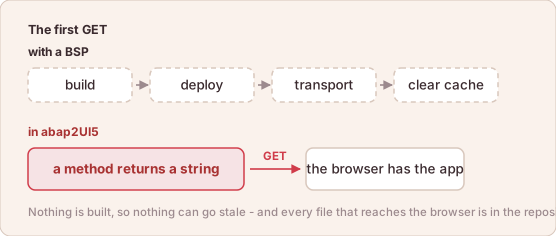
Four steps, or a method that returns a string.
The consequence is a project made of nothing but ABAP, and everything below follows from it.
No build. Pull the repository with abapGit, activate, call the ICF node. No npm install, no bundler, no dist folder, no separate deployment path that has to succeed for the app to exist. Nothing that can be broken by a transitive dependency you have never heard of releasing a patch on a Friday.
No deployment. The app is a class. Activating it is the deployment, and the standard transport system moves it to production like any other ABAP object. There is no state in which the backend is live and the frontend is not — which is the state most Fiori incidents are actually about.
No cache to invalidate. The UI is built on every request (#5), so there is no build output that can be stale. Nobody runs a cache transaction, nobody asks a colleague to hard-refresh, and a change that does not appear is a change that was not activated.
No IDE agreement. It is ABAP. ADT, SE80, or a VS Code setup — that stays a personal preference rather than a project decision, and nobody has to install a frontend toolchain to fix a label.
No context switch to debug. A breakpoint in the method that built the view stops in the method that built the view. The browser dev tools stay closed, because the logic that produced the screen never left the backend.
No supply chain to answer for. A frontend build pipeline is a dependency tree, and a dependency tree is something somebody has to audit, pin and renew. A project whose frontend ships as ABAP source has one thing to review: the source. Every file that reaches the browser is in the repository, readable, diffable, and transported by the system that already governs everything else.
Individually these are conveniences. Together they change which questions get asked out loud: when an experiment costs a class and a refresh, "could we just show this on a screen?" stops being the opening of a project and becomes something you try before lunch.
Iteration speed is not a nice-to-have. It decides which ideas get built at all.