
#25 Where the View Lives
Three ways to put a UI5 screen in front of a user on an ABAP stack. All three render in the browser, with the same control library, through the same framework. What differs is one thing: where the view is defined, and therefore when it is fixed.
UI5 Freestyle — build time. The XML view is a file in a frontend project. It is written in the IDE, built, and deployed alongside its controller. The backend serves data through OData or a REST service and has no opinion about the screen. By the time a user opens the app, the view has been fixed since the build.
RAP with Fiori Elements — activation time. There is no view file per screen. The screen is described as UI annotations on CDS entities, and a Fiori Elements runtime in the browser turns that metadata into controls at load time. The definition lives in the backend and is fixed when the annotations are activated.
abap2UI5 — request time. The view is an XML string an ABAP class produced for this request, rendered by a shell app that is the same for every application. It is fixed when the request is answered, and the next request may answer differently.
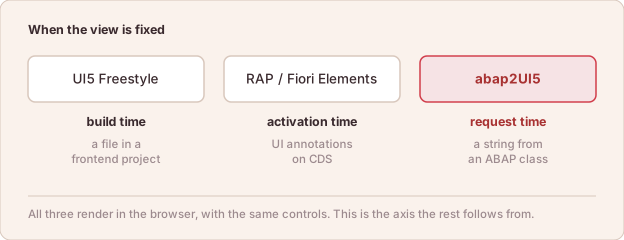
One axis: when the definition of the screen stops being changeable.
Everything else follows from that axis. What has to be deployed per app, how many artefacts a screen costs, what can still change at runtime, which language the definition is written in — none of those are independent choices, they are consequences of where the view sits.
Which is also why none of this reads as a ranking. A definition fixed early is easier to standardise and to keep consistent across hundreds of screens. One fixed late can adapt to things nobody knew at design time. Those are different properties, not different amounts of the same one.
Pick where the view lives, and most of the other decisions have already been made for you.
Happy ABAPing! 🦖🦕🦣