#6 The Frontend Knows Nothing
The first GET request delivers a UI5 app to the browser. It is worth asking what is actually in it.
Not the screen. Not the fields, not the table, not the buttons, and not what any of them do. The app that arrives is a shell: enough UI5 to take a view and a model from the server, render them, and send events back. It cannot tell whether it is currently showing a table, a form or a wizard, and it does not know which action follows the next click.
Everything it needs arrives per request. Everything it decides is decided on the server.
The pattern has a name: a Hypermedia-Driven Application. Between the multi-page app, where every interaction fetches a whole document, and the single-page app, which holds routes and state in the browser and needs a rebuild to change either, an HDA renders what the server sends and knows nothing else. It is the sweet spot those two leave open, and it is where htmx, Hotwire and LiveView all sit.
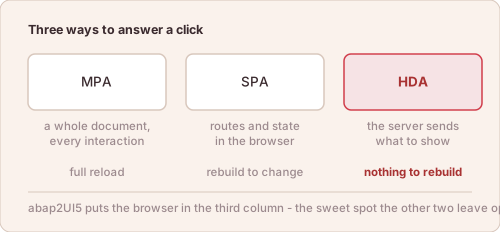
Multi-page, single-page, hypermedia-driven — and what each has to rebuild.
That is the same division of labour SAP GUI had. PBO builds the screen, the user acts, PAI receives the event and decides what happens next. The dialog step moved to AJAX and the screen became an XML view, but the shape of the conversation did not change — which is why the flow reads as familiar to anyone who has written a module pool, and as strange to anyone who has only written SPAs.
The consequence is the part worth keeping. There is one shell, and every app in the system shares it. Not one deployed frontend per app, drifting to a different UI5 version, a different bootstrap, a different set of libraries, each pinned to whenever someone last had time to touch it. One artefact to keep current, and every app is current with it.
A frontend that knows nothing about the app is a frontend that never needs to be redeployed when the app changes.
Happy ABAPing! 🦖🦕🦣