#7 The Same Service for Every App
Count what a screen usually costs in backend artefacts. A CDS view or two, a service definition, a service binding, a behavior definition and its implementation, a projection — each one named, transported, reviewed, and each one belonging to exactly one application.
An abap2UI5 app adds none of them — and there is no SEGW project underneath either. Every app in the system is served by the same generic HTTP handler, and it is generic in a specific way: it does not know the app, the view or the model. It moves two strings.
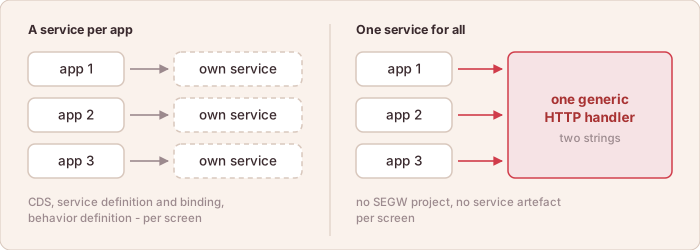
A service per screen, against one handler that knows none of them.
That is visible from inside. Set a breakpoint in an app class and look at the call stack — there is one frame between the app and the handler. No OData runtime, no SADL, no Gateway.
The reason it can be generic is that nothing about the data is agreed in advance. In an OData conversation the metadata comes first and fixes the shape; data follows within that shape for the rest of the session. Here the model travels with every response, so each response may carry a different one. There is no contract to violate because there is no contract to register.
What that removes is not effort — the app still decides everything — but artefacts. A screen stops being a set of objects to create, name, transport and govern, and becomes a class. In a landscape where every new object is something someone has to review, keep clean and eventually migrate, the cheapest artefact is the one that was never created.
A service that knows nothing about the application never has to be written again for the next one.
Happy ABAPing! 🦖🦕🦣