#17The Client API: What the Client Can Do
The whole of z2ui5_if_client by shape - show a screen, bind data, read the event, navigate, message, follow-up actions - before knowing it by name.
2 min read · 17 of 42
The app implements one interface with one method. The single parameter of that
method is the other interface, z2ui5_if_client. It is everything an app can
ask the framework for, and it is small. The table groups its methods by what
the app wants to do:
| The app wants to… | …and calls |
|---|---|
| show a screen | view_display( ), popup_display( ), popover_display( ), nest_view_display( ) |
| put ABAP data on that screen | _bind( ) — the attribute, by reference, both directions |
| find out what the user did | check_on_event( ), get_event( ), get_event_arg( ) |
find out why main( ) was called |
check_on_init( ), check_on_navigated( ) |
| talk to the user | message_toast_display( ), message_box_display( ) |
| move to another app and back | nav_app_call( ), nav_app_leave( ), get_app_prev( ) |
| ask the browser to do something | follow_up_action( ) with a cs_event constant |
| know where it runs | get( ) — device, launchpad, URL parameters, the raw event |
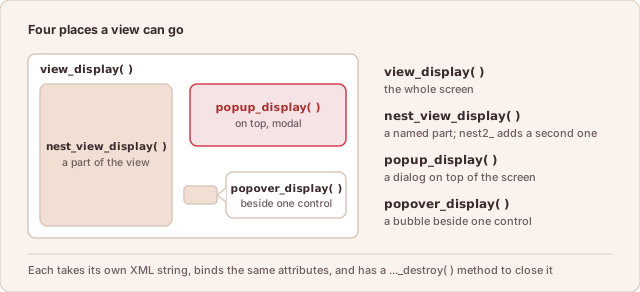
The four places the first row of the table fills.
The API is small enough to remember, and that was a design goal.
Two of the smallest rows do the most work. _bind( ) takes an
ABAP variable and returns the binding path the view needs; the framework builds
the model around whatever was bound, ships it, and writes the user’s changes
back into the same variable:
    )->tag( `Input`
        )->a( n = `value` v = client->_bind( customer )
And _event( ) names what the frontend should send when a control fires:
    )->tag( `Button`
        )->a( n = `text`  v = `Save`
        )->a( n = `press` v = client->_event( `SAVE` ) ).
Both only return a string. The attribute name and the event name are written into the view and read back from the request; nothing is registered or declared anywhere else.
The last row covers everything that is a browser matter rather
than an ABAP matter — focus a field, scroll, copy to the clipboard, download a
file, set the tab title, raise the model size limit. Each is a constant in
cs_event, and each is one call:
    client->follow_up_action( val   = client->cs_event-set_focus
                              t_arg = VALUE #( ( `inputCustomer` ) ) ).
The full list with every parameter is on the Client API page. It is generated from the interface itself, so it always matches what the framework offers.
In short: an app talks to the framework only through client: show a
view, bind data, read the event, navigate, show a message, ask the browser to
do something.