#10Only the Changed Part
Why the view is not sent on every click - an event changes the model alone, UI5 data binding updates the bound controls, and focus, scroll and half-typed input survive.
2 min read · 10 of 42
If the backend sends the view on every request — #6 — does the screen rebuild itself on every click?
It would, and the user would notice at once. A rebuilt view is a new set of controls: the cursor leaves the field, a half-typed entry is gone, the table scrolls back to the top. Nobody wants to type a customer name three times.
So the view is not sent every time. Sending it is a decision the app makes:
  METHOD z2ui5_if_app~main.

    me->client = client.

    IF client->check_on_navigated( ).
      view_display( ).      " first display, and every return from a sub-app
    ELSEIF client->check_on_event( `COUNT` ).
      count = count + 1.    " changes the model - and nothing else happens
      " no view_display( ) here: the response carries the model alone
    ENDIF.

  ENDMETHOD.
count is a public attribute bound to a Text in the view. Every press of
the button runs main( ), and main( ) changes a number and returns.
When the app does not call its view_display( ), the response carries the
model alone. The browser keeps the view it already shows, and UI5 handles the
changed model as it always does: data binding updates the controls bound to
what changed, and touches nothing else.
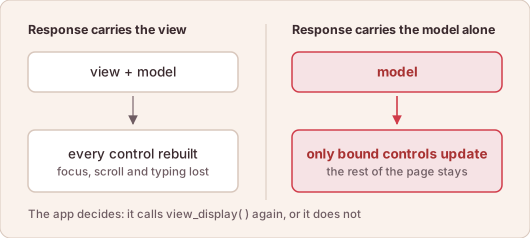
What a response carries decides what survives on the screen.
The DOM is not rebuilt. Focus stays in the field. The scroll position holds. The value the user is halfway through typing survives, because the input control was never replaced — only its bound value was.
The Over-the-Wire frameworks outside SAP do the same with HTML fragments. UI5 does it with a mechanism it has always had: a model changed, and the binding updates the control. No diffing algorithm, virtual DOM or reconciler is involved.
In short: an event normally changes only the model; the app sends the view again only when the structure of the screen changes.